
Intro
Why More Leads Is the Wrong Goal for Sales Teams in 2026
Most sales teams do not have a lead problem
- They have an attention problem.
- When pipeline slows down, the default reaction is usually:
- “We need more leads.”
- So teams buy larger lists, expand targeting, and increase outreach volume.
- At first, it feels productive.
- More names. More emails. More activity.
But after a few weeks, most teams end up in the same place:
- Low reply rates
- More bad-fit prospects
- Reps spending hours sorting through noise
- Pipeline that still feels unpredictable
Because more leads rarely solve the real problem.
Why “more leads” creates more problems
The logic seems simple:
If you reach out to more people, you should create more opportunities.
But in practice, volume often creates the opposite effect.
More leads = more noise
When lists get bigger, quality usually goes down.
Sales teams end up chasing:
- Prospects with no real intent
- Companies that are not a fit
- Contacts who are unlikely to respond
Instead of helping reps move faster, more leads slow them down.
More leads = more manual work
Large lists create hidden work:
- Cleaning data
- Validating contacts
- Prioritizing accounts
- Rewriting generic outreach
The result is that reps spend more time managing leads than talking to prospects.
More leads = lower conversion rates
When teams focus on volume, messaging becomes broader and less relevant.
Outreach starts to sound the same:
- Generic subject lines
- Templated messaging
- Little connection to timing or context
That leads to lower engagement and fewer qualified conversations.
What high-performing sales teams do instead
The best sales teams in 2026 are not asking:
“How can we get more leads?”
They are asking:
“How can we find the right opportunities at the right moment?”
That means focusing on:
- Timing
- Relevance
- Intent
- Context
Because a small number of high-intent opportunities can outperform thousands of random contacts.
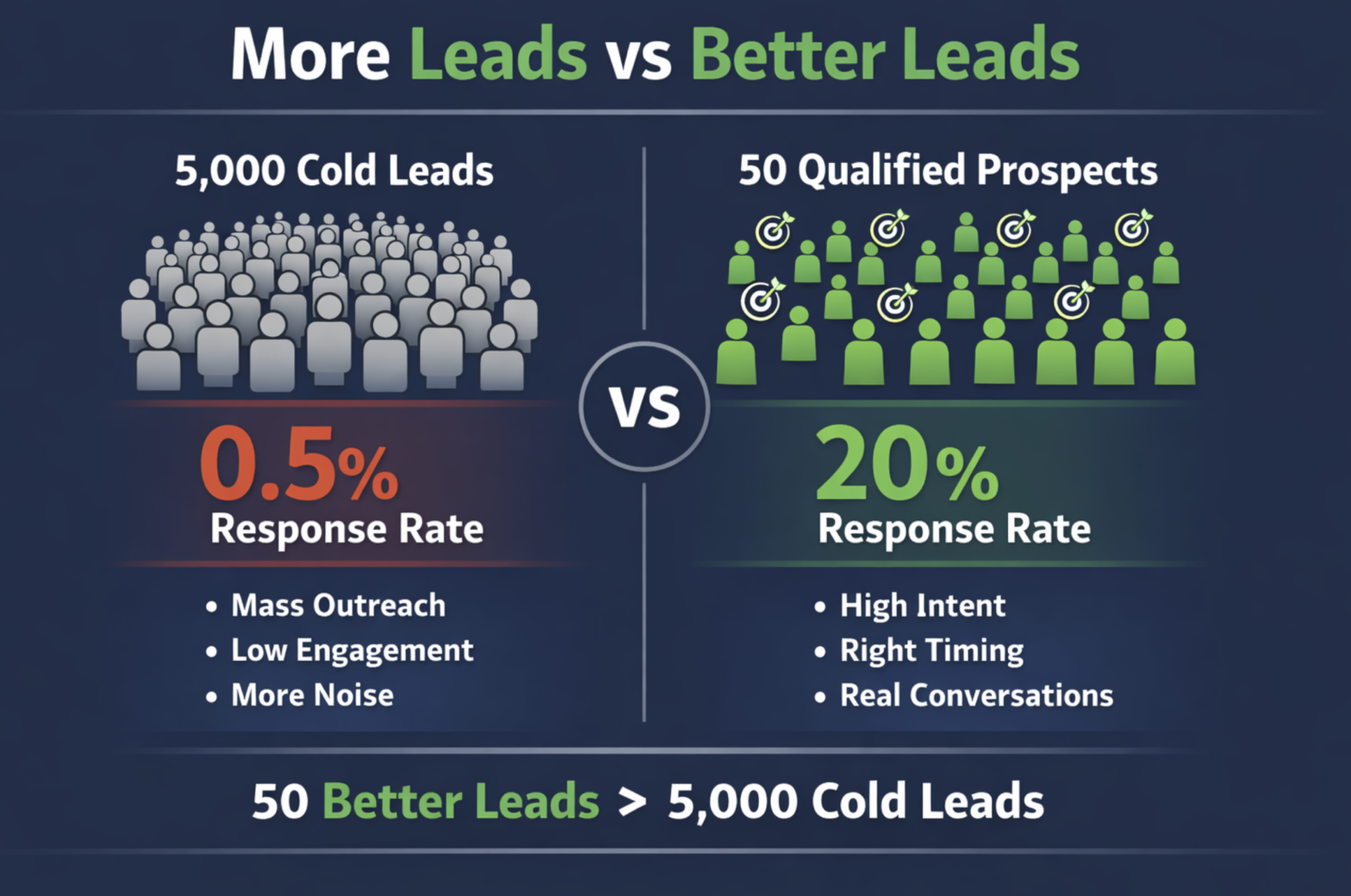
Why 50 high-intent prospects beat 5,000 cold leads
Imagine two prospecting strategies:
Strategy A
- 5,000 cold leads
- Generic messaging
- No signal or timing
- 0.5% response rate
Strategy B
- 50 high-intent prospects
- Signal-based outreach
- Messaging tied to timing and context
- 20% response rate
Which one creates more pipeline?
The answer is obvious.
High-performing teams know that precision scales better than volume.
The shift from lead generation to signal generation
Traditional prospecting is built around lists.
Modern prospecting is built around signals.
Instead of asking:
- Who can we email?
The better question is:
- Who is showing signs that now is the right time to reach out?
Signals could include:
- Company changes
- New initiatives
- Hiring activity
- Market events
- Public indicators of buying intent
These signals create context.
And context creates conversations.
Where FAC Intelligence fits
FAC Intelligence is built around this idea.
Instead of overwhelming teams with more names, it continuously identifies:
- The right prospects
- At the right time
- With the right context
That means less manual work, better conversations, and more predictable pipeline.
Final thoughts
If your strategy for hitting pipeline goals is simply “get more leads,” you may be making the problem worse.
Because the future of prospecting is not more volume.
It is better timing.
The teams that win in 2026 will not be the ones with the biggest lists.
They will be the ones that know exactly who to reach out to—and when.
Call to action
If your team is still optimizing for lead volume, it may be time to rethink what growth actually looks like.
Because more leads do not create more pipeline.
The right leads do.
Contact us today to learn more.